
Emotional triggers in copywriting that drive signups
Master these emotional triggers to transform your website copy into a conversion powerhouse that connects with visitors on a psychological level and drives meaningful action.
- Emotions drive 95% of purchasing decisions – Focus on emotional connection first, then support with logical arguments to maximize conversion rates.
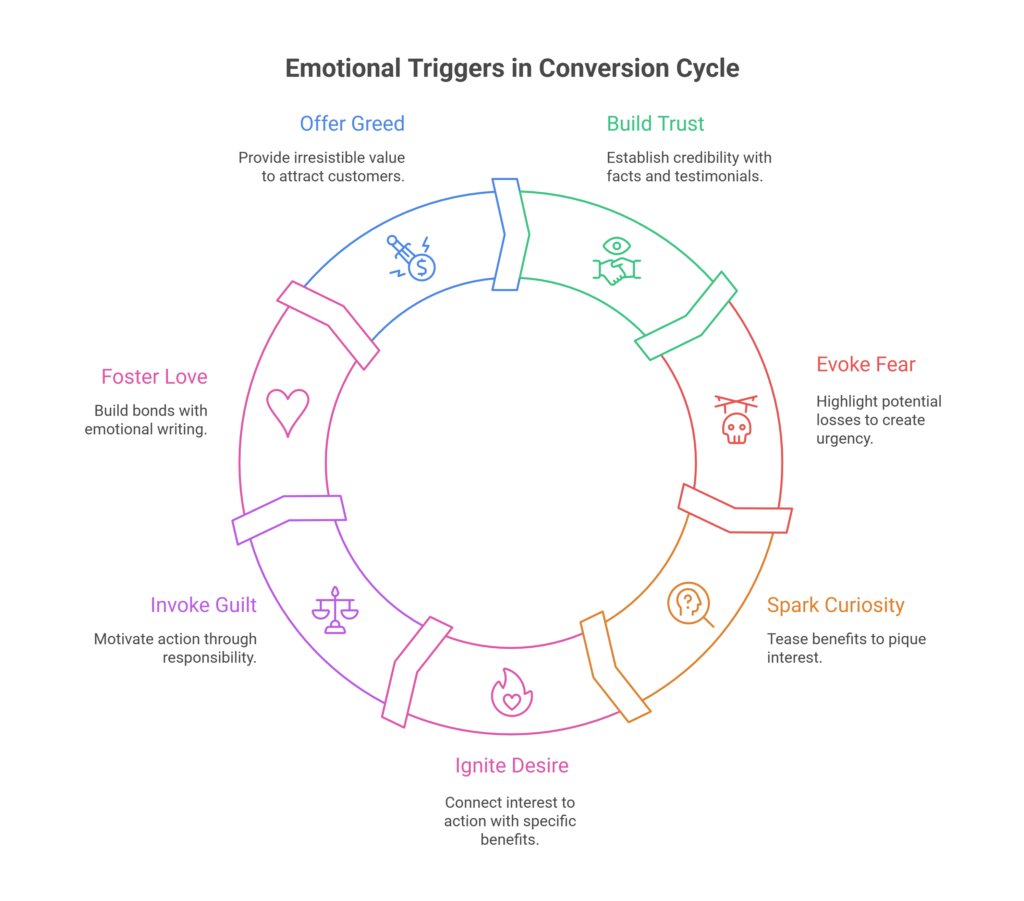
- Seven core triggers boost signups: Trust (safety), Fear (loss), Curiosity (information gaps), Desire (benefits), Guilt (responsibility), Love (connection), and Greed (value).
- Strategic placement matters – Use trust and curiosity on homepages, urgency and desire on landing pages, FOMO for email opt-ins, and social proof in testimonials.
- Avoid manipulation tactics – Overusing fear/guilt, empty clickbait, or ignoring audience context damages credibility and reduces long-term effectiveness.
- Test and personalize triggers – Different audiences respond to different emotional stimuli, so research your market and test what resonates with your specific visitors.
The key to successful emotional copywriting lies in creating authentic connections that guide visitors naturally toward taking action, rather than forcing decisions through manipulation.
Trigger words can turn ordinary copy into powerful conversion machines. Research from Disney Institute shows that customers who feel emotionally connected are three times more likely to recommend products and make repeat purchases. This makes emotional triggers in copywriting crucial to boost website signups.
Website copy does more than combine words—it creates psychological pathways that prompt action. Studies reveal that 97% of consumers let online reviews shape their buying decisions. This shows how emotions guide purchasing behavior. Smart use of trigger words taps into these psychological responses. Adding a reader’s first name to email subject lines boosts open rates by 26%.
This piece explores seven emotional triggers that can revolutionize your website copywriting and boost your conversion rates. We’ll show you how to ethically use powerful persuasion techniques in your digital presence, from creating urgency with fear-based triggers to building trust that makes visitors feel secure.
Why do emotional triggers matter more than logic in copywriting?
Emotional triggers matter because around 95% of purchasing and signup decisions are driven by subconscious emotions, not rational analysis. Logic helps justify a decision, but emotion is what initiates action.
The psychology behind emotional triggers
Research into decision-making reveals a surprising fact: our subconscious mind drives 95% of purchasing decisions, with emotions playing a bigger role than logic. This emotional base shapes our response to copywriting and determines if website visitors will take action.
Why emotions influence decisions
Neuroscientist Antonio Damasio’s research revealed something fascinating about decision-making. People with damaged connections between their brain’s “thinking” and “emotional” centers could think rationally but couldn’t make decisions. They remained stuck in indecision because they couldn’t use emotions to assess their choices. Brain scans from functional MRI studies show that consumers rely more on emotions than product features or facts when looking at brands.
Our brains work through two distinct systems:
- System 1: Fast, automatic, emotional, and easy-to-use
- System 2: Slow, thoughtful, logical, and analytical
Many people think website visitors mainly use System 2. The reality shows that System 1 takes the first step—and often makes the final decision.
How emotional triggers work in copywriting
Psychological triggers spark strong responses from joy and trust to fear and surprise. Good website copywriting uses these triggers to build emotional connections before addressing logical concerns.
Different triggers resonate with different audiences. Understanding your target market becomes vital for success. Your marketing messages should feel personal to help people feel more in control and open to your message.
The link between emotion and action
Emotions drive action. Humans naturally respond to emotional triggers—whether they click a signup button, share content, or buy something.
Emotional connections significantly affect business results. A major bank created a credit card to connect with millennials emotionally. Card usage jumped by 70% and new accounts grew by 40%. Campaigns focused purely on emotions performed almost twice as well (31% vs. 16%) compared to rational content alone.
Trigger words in copywriting succeed because they tap into our emotional decision-making process and create the right psychological conditions that lead to action.
7 emotional triggers that drive signups
What emotional triggers are most effective for increasing signups?
The most effective emotional triggers for signups are trust, fear of loss, curiosity, desire for benefits, guilt-driven responsibility, love and belonging, and perceived value or gain. Each trigger influences motivation differently depending on context.
Emotional triggers push people to make decisions and take action. These psychological levers create instant connections that make visitors want to take the next step. Here are the most powerful triggers that boost conversions.
1. Trust: Make your audience feel safe
How does trust-focused copy increase signup rates?
Trust-focused copy reduces perceived risk by using social proof, testimonials, data points, and clear messaging, making visitors feel safe enough to share their information or commit to a signup.
Your success depends on building credibility. People buy from those they trust. Using facts and data makes your copy more persuasive. Customer testimonials work as strong trust signals because they show real proof that your solution works.
2. Fear: Show what they might lose
Messages based on fear activate the amygdala and can override rational thinking. This creates a sense of urgency that pushes people to act now. The best fear-based messages combine serious threats that make people think “that could be me” with clear solutions that show “I can do something about it”.
3. Curiosity: Spark interest with open loops
How does curiosity-driven copy encourage users to sign up?
Curiosity-driven copy creates open information loops that make readers want closure. By teasing benefits without revealing everything, it motivates users to sign up to access the missing information.
The curiosity gap makes readers want closure. It’s that space between what we know and what we want to know. Our brains naturally try to fill information gaps when they seem manageable – not too big or small. You can create a “slippery slide” effect by teasing benefits without revealing them right away.
4. Desire: Tap into what they want most
Desire connects interest to action. You can make it stronger by showing specific benefits that match your audience’s deeper wants. Research shows emotions guide our choices first, and we rationalize them later. Start with emotional benefits before moving to logical ones.
5. Guilt: Use responsibility to motivate action
Guilt makes people want to improve themselves – even in areas unrelated to what made them feel guilty. Unlike shame which hurts self-worth, guilt keeps people’s sense of value intact while pushing them to make things right.
6. Love: Appeal to connection and care
Strong emotional writing builds powerful bonds between your audience and brand. Use “you” more than “we” to show you’re listening to your readers. Your brand becomes more relatable and trustworthy when you show vulnerability.
7. Greed: Offer irresistible value
Greed works because people always look for maximum gain. Both buyers and sellers want to “win” in every deal. You can tap into this motivator by showing overwhelming value. Just make sure your offers provide real value to keep trust over time.
How to use emotional triggers in website copywriting
Where should emotional triggers be placed on a website for maximum impact?
Emotional triggers should be placed strategically: trust and curiosity on homepages, urgency and desire on landing pages, FOMO in email opt-ins, and social proof within testimonials and checkout-related sections.
Each page type on your website needs a different approach to emotional triggers. You must understand how every page fits into your conversion funnel.
Homepage: Build trust and curiosity
Your homepage makes first impressions that decide if visitors stay or leave. A clean, consistent design shows reliability and helps build credibility. You should display client logos, certifications, and awards as trust signals that trigger the authority principle. Studies show websites with detailed content about services show expertise. Add detailed information while keeping things clear. Create curiosity by teasing benefits without showing everything—this creates information gaps that visitors want to fill.
Landing pages: Use urgency and desire
Landing pages work best with urgency elements that stop people from putting things off. Countdown timers for limited offers work as visual reminders of deadlines. You can also show limited stock to create a sense of scarcity. Use timing words in CTAs like “Get Started Today” instead of basic “Sign Up” buttons. Your message should focus on what visitors get by acting now—quick results motivate people to take action.
Email opt-ins: Make use of fear of missing out
FOMO (Fear Of Missing Out) gets people to sign up for emails. Give exclusive access to content, early product releases, or members-only discounts to make people feel they belong. Short flash sales that last 24 hours or less create panic about missing deals. Your subject lines should create FOMO since 35% of people decide to open emails before seeing what’s inside.
Testimonials: Build social proof and trust
Testimonials help bridge the gap between prospects and purchases. Add specific testimonials that tackle common worries. People trust other customers’ words more than your own claims. Reviews that show success stories work as social proof, especially with real names, photos, and company details. Put testimonials on conversion pages rather than keeping them all on one testimonials page.
Conclusion
Emotional triggers turn basic website copy into powerful tools that generate real results. Research shows that 95% of buying decisions happen in our subconscious mind. This insight gives marketers and business owners a powerful advantage.
Trust, fear, curiosity, desire, guilt, love, and greed tap straight into our audience’s psychological needs. Many businesses focus only on features instead of feelings. But the most successful websites create emotional connections first and back them up with logic later.
Your website needs these triggers in all the right places. The homepage builds trust and sparks curiosity. Landing pages create urgency and desire. Email sign-ups work best with FOMO, while testimonials add social proof that builds confidence.
Of course, you need to use emotional triggers responsibly. Too much fear or guilt, clickbait tactics, or misreading your audience will hurt your results and damage trust. The goal is to build genuine connections, not manipulate people.
These emotional triggers create a natural path that guides visitors to take action. People rarely buy based on facts and numbers alone. They make purchases because something feels right or solves their problems. Speaking to these emotional drivers will help turn casual visitors into loyal customers.
Frequently Asked Questions
What are emotional triggers in copywriting?
Emotional triggers are psychological stimuli used in copywriting to evoke strong responses from readers. They tap into universal emotions like trust, fear, curiosity, desire, guilt, love, and greed to influence decision-making and drive action.
How do emotions influence purchasing decisions?
Research shows that up to 95% of purchasing decisions happen subconsciously, heavily influenced by emotions rather than logic. Our brains are wired to respond to emotional stimuli, which often guide our choices before rational thinking comes into play.
What are some effective emotional triggers for website copywriting?
Some powerful emotional triggers include building trust through credibility, creating urgency with fear of missing out, sparking curiosity with information gaps, tapping into desires by highlighting benefits, and leveraging social proof through testimonials.
How can I use emotional triggers on different website pages?
Different pages require different approaches. For example, use trust and curiosity on homepages, urgency and desire on landing pages, fear of missing out for email opt-ins, and social proof in testimonials. Tailor your approach to each page’s specific purpose in the conversion funnel.
What are common mistakes to avoid when using emotional triggers?
Common pitfalls include overusing fear or guilt, which can lead to audience paralysis or negative brand associations. Using clickbait without delivering value can damage credibility. It’s also crucial to avoid ignoring your specific audience context, as different triggers work for different markets.

Author: Arsh Sanwarwala
Arsh Sanwarwala is the Founder and CEO at ThrillX. He is passionate about UX/UI Design, conversion optimization, and all things digital.