
Warning Signs Your Website is Silently Leaking Conversions
Your website might be silently bleeding potential customers through invisible conversion leaks that compound over time, costing you significant revenue without obvious warning signs.
Track user behavior religiously – Without proper analytics and attribution, you’re flying blind while 96% of dissatisfied visitors leave without reporting issues.
Speed kills conversions instantly – Pages loading over 3 seconds lose 70% of potential conversions, with mobile users especially unforgiving of slow experiences.
Clarity trumps clever design – Overloaded navigation and unclear value propositions confuse visitors in the critical 6-second evaluation window.
Test everything systematically – A/B testing and heatmap analysis reveal what actually works versus assumptions, often improving conversions by 20-30%.
Optimize for AI and search visibility – Poor content structure and missing schema markup prevent your site from appearing in search results and AI answers.
The most dangerous aspect of these conversion leaks is their invisibility – they gradually erode your business potential rather than causing sudden, noticeable drops. Start by implementing proper tracking to identify your biggest leaks, then systematically address speed, clarity, and testing issues for maximum impact.
Website visitors make first impressions in just 50 milliseconds. You have only eight seconds to capture their attention before they leave. These crucial moments determine if your website’s conversion leaks drain your business of potential customers. A striking 96% of unhappy visitors won’t report problems—they simply leave, which makes these conversion issues almost impossible to spot.
Your conversion funnels rarely fail because of one obvious mistake. Small issues pile up over time and gradually drain potential sales. B2B SaaS sites often show bounce rates of 60% or higher, while the industry average hovers around 30%. This gap in website conversion rates affects your profits directly. A page that loads in one second converts five times more leads than one that takes 10 seconds. Mobile devices now generate 63.15% of all website traffic, so your conversion rate likely suffers if you haven’t optimized the mobile experience.
This piece will help you spot the warning signs that your website silently loses conversions. You’ll learn practical solutions to fix these problems before they harm your business.
You don’t know where conversions are dropping
Why is missing analytics the most dangerous conversion leak?
Missing or poorly configured analytics is the most dangerous conversion leak because it hides where users abandon the funnel. Without event tracking, funnel analysis, and attribution, businesses can’t identify friction points or prioritize fixes, allowing revenue loss to continue unnoticed.
Website conversion leaks become most alarming when you have no idea where potential customers abandon your sales funnel. This digital blindspot costs businesses thousands in lost revenue daily. Business owners often look at top-line metrics like total visitors and conversions, yet they fail to recognize that the path between these points holds the key to better website conversion rates.
Missing or outdated analytics tools
Most businesses set up Google Analytics during website creation but never configure it properly afterward. So they collect mountains of data without extracting meaningful insights. Modern analytics needs thoughtful implementation with:
Custom event tracking for key user interactions
Properly configured goal funnels to measure multi-step processes
Regular dashboard reviews to identify sudden changes in behavior
Relying on outdated analytics platforms means missing critical mobile insights when mobile traffic now dominates. Your business likely misses conversion optimization opportunities on devices most visitors use without mobile-specific user analysis.
No clear attribution for leads
The most frustrating conversion leak happens when leads appear in your system without proper source attribution. Businesses using multiple disconnected tools face this issue: one for website analytics, another for lead capture, and a third for CRM management.
Marketing teams can’t determine which channels drive quality leads and make budget decisions based on incomplete data. Your paid social campaigns might drive numerous low-quality leads while organic search brings fewer but higher-converting prospects. Wrong channel investments happen without proper attribution.
This attribution blindness affects content effectiveness too. Your website’s traffic to lead conversion rate might be strong overall, but certain content pieces could substantially outperform others. These high-performing assets remain hidden gems rather than models for future content creation without content-specific conversion tracking.
The cascade of problems starts when you can’t trace where conversions drop. Teams argue about priorities without data to support decisions. Design changes get implemented without baseline metrics to measure improvement. Most importantly, potential customers continue to leak from your funnel while the exact causes remain unknown.
Your site looks fine but feels confusing
Why does unclear messaging cause visitors to leave within seconds?
Unclear messaging causes visitors to leave because users evaluate websites within the first 6 seconds. Overloaded navigation, vague value propositions, and weak calls to action create confusion and decision paralysis, preventing visitors from quickly understanding what to do or why they should stay.
Businesses spend money on attractive website designs but don’t deal very well with website conversion leaks. User studies show visitors take just over 6 seconds to check site menu navigation. These first impressions matter a lot. A beautiful interface won’t guarantee conversions if users feel lost or confused by the experience.
Overloaded navigation and unclear CTAs
Poor navigation stands out as one of the biggest conversion killers. Research shows 61.5% of users abandon websites because they can’t find their way around. Users get lost when menus become too complex – this happens most with more than 10 subcategory options.
Mobile devices make these problems worse. Users waste time scrolling through endless navigation options. Sites often miss showing users where they are – this ranks as the most frequent menu mistake seen in usability studies.
CTAs need serious work too. Buttons fade into the background without specific, action-focused text that shows clear benefits. One expert puts it simply: “If your copy is hard to find, read, or understand, it won’t convert”. The best CTAs use smart placement, stand out visually, and use powerful words to boost conversions and website traffic.
Too much copy, not enough clarity
Content overload creates the next big confusion point. Website visitors scan rather than read long text blocks. Pages full of dense text frustrate users looking for specific details.
Website copy that works needs:
Bite-sized paragraphs users can scan
Important points right at the start of headlines
No jargon or unnecessary fluff
One industry expert nails it: “One of the biggest mistakes is focusing too much on cleverness instead of clarity”. Clarity doesn’t mean dumbing things down – it means organizing content logically so everyone can understand it. Website conversion examples prove that clear, direct copy beats wordy alternatives every time.
No clear value proposition above the fold
The biggest problem shows up when websites miss having a strong value proposition right where users first look. About 40% of website users check navigation links and layout the moment they land. Many sites waste this prime space with unclear messages or distracting elements.
Great value propositions quickly show why customers should pick your product over others. They connect what you offer to what customers need. Users have to work harder without this clarity to see if you solve their problems – most won’t bother trying.
Forbes data shows users spend just 6 seconds on site navigation compared to 54 seconds average page time. Your value proposition needs to make sense right away in this tiny window. Psychologists call it “decision paralysis” when users leave because options seem overwhelming or unclear.
Navigation confusion, content overload, and weak value propositions create a perfect storm of website conversion leaks. This happens whatever your site’s visual appeal might be.
Your website is slow and users don’t wait
How does website speed impact conversions, especially on mobile?
Website speed directly impacts conversions, especially on mobile. Pages that take longer than 3 seconds to load can lose up to 70% of potential conversions. Even a one-second delay significantly increases bounce rates and reduces trust, making speed optimization critical for revenue growth.
Speed kills conversions—there’s no gentler way to put it. I’ve looked at hundreds of website conversion leaks, and page speed ranks among the most critical factors that affect your bottom line. Your potential customers take their wallets with them as they hit the back button because your site loads too slowly.
Mobile load time over 3 seconds
The three-second threshold is real. Users expect pages to load within 3 seconds. The average mobile landing page takes 15.3 seconds to fully load, and this disconnect creates massive website conversion leaks. Nearly 70% of consumers say that page speed affects their decision to buy from an online retailer.
Here’s a reality check: A one-second delay in mobile load time can affect conversions by up to 20%. The numbers get worse. The probability of bounce jumps by 90% as page load time goes from 1 second to 5 seconds. These figures show why speed optimization isn’t optional—businesses need it to survive in today’s digital world.
Heavy images and unoptimized code
Bloated websites kill conversions. Uncompressed images make up 50-90% of a page’s total weight and slow down load times dramatically. Pages also display slowly because of render-blocking JavaScript and CSS. This frustrates users who might otherwise convert.
Your website conversion rate relates directly to these technical details. Pages loading in 2.4 seconds convert at 1.9% on average. Pages that take 5.7+ seconds convert at just 0.6%. Load times alone can cause a 70% drop in conversion potential.
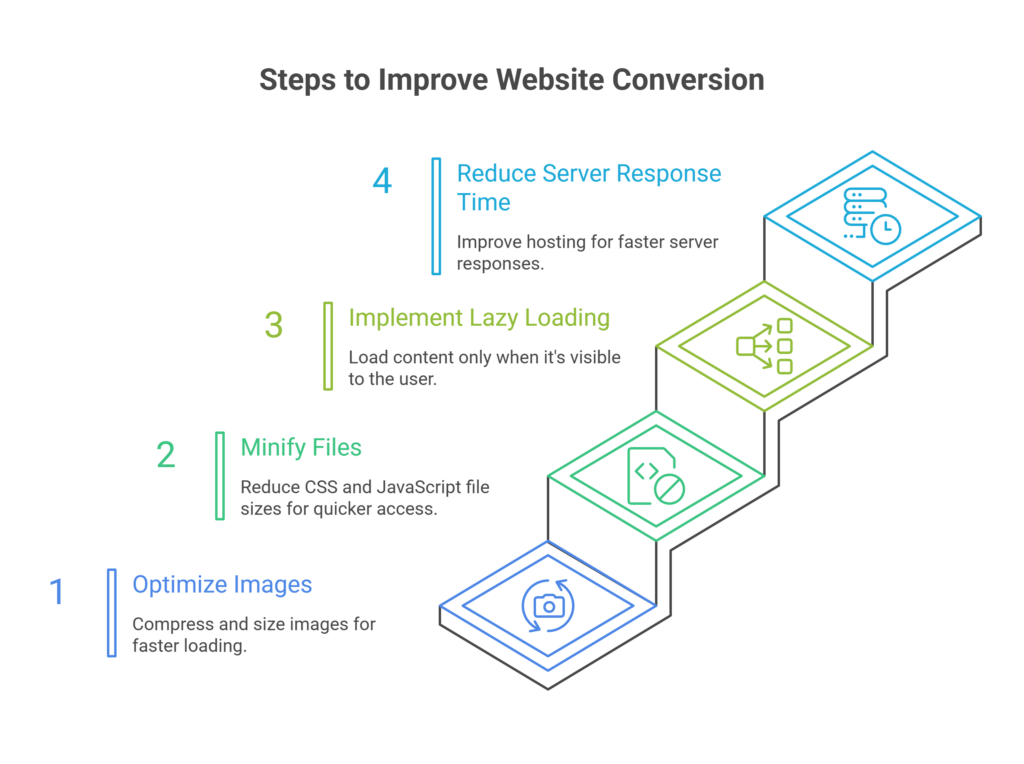
To improve your website traffic to lead conversion rate, focus on:
Compressing and properly sizing all images
Minifying CSS and JavaScript files
Implementing lazy loading for below-the-fold content
Reducing server response time through better hosting
No performance monitoring in place
Maybe the most troubling sign is having no system to track performance metrics. Sites gradually slow down as new features, plugins, and content pile up without regular monitoring. Teams often notice this creeping degradation after conversion rates have already dropped.
The best website conversion examples come from businesses that use continuous performance monitoring. One e-commerce site found their checkout page loaded in 7.2 seconds—nowhere near the 3-second target. They cut load time to 2.1 seconds after optimization and saw a 28% increase in completed transactions.
Site speed isn’t just a technical concern—it’s crucial for business. Every extra second of load time breaks user trust and patience. This creates invisible but devastating website conversion leaks. You can get those lost conversions back by making performance a priority through mobile optimization, proper image handling, code cleanup, and continuous monitoring.
You’re not showing up in search or AI answers
Why does poor SEO and AI visibility reduce conversions before users arrive?
Poor SEO and AI visibility reduce conversions before users even reach your website. Weak content structure, missing schema markup, and lack of educational content prevent pages from appearing in search results and AI-generated answers, cutting off top-of-funnel traffic and future conversions.
Websites that can’t be found don’t convert visitors—period. Your site’s absence from search results and AI-generated answers creates critical website conversion leaks that businesses often miss. Search invisibility quietly drains your funnel before prospects can even find your domain.
Poor content structure for LLMs
Large Language Models (LLMs) power search engines and AI assistants today, but most websites still cater to outdated algorithms. These advanced systems need content with logical structure, clear headings, short paragraphs, and connected ideas. Sites with messy information architecture confuse AI crawlers. This prevents your content from appearing in answers.
Your website conversion rate will improve if you structure content as questions and answers that match real search patterns. This makes your content easy to digest for humans and helps AI systems decide which sites deserve visibility.
No schema markup or SEO basics
Schema markup helps search engines understand your content’s meaning, but many sites don’t use this valuable code despite how it affects visibility. Search engines don’t identify your valuable content, pricing information, or product details without this structured data.
Many sites also skip these essential SEO practices:
Missing meta descriptions and title tags
Incomplete alt text for images
Keyword stuffing instead of natural language optimization
Poor internal linking structure
These gaps let competitors grab traffic that should be yours, which hurts your website traffic to lead conversion rate.
Lack of educational content for top-of-funnel
We focus too much on bottom-funnel content like pricing pages and product specs. This means missing chances to connect with potential customers who are still researching. Educational content attracts visibility and builds trust with prospects who aren’t ready to buy yet.
The best website conversion examples show businesses that create complete resource centers. They answer common industry questions. This strategy captures organic traffic and establishes your brand’s expertise—essential for converting uncertain prospects later.
Technical skills and content strategy work together to fix search and AI visibility issues. The results speak for themselves: websites optimized for modern search algorithms and AI systems see 10-30% better conversions without changing any design elements or button colors.
You’re not testing or learning from your traffic
Your website visitors’ behavior holds the key to untapped revenue. Many businesses gather traffic data but don’t analyze or act on it. This creates major website conversion leaks without them knowing it.
No A/B testing or heatmaps
You’re just guessing what works best when you don’t test different versions of your pages. A/B testing lets you compare variations of web elements—headlines, images, CTAs—to find what performs better. Without doubt, businesses that run regular A/B tests see conversion improvements of 20-30% over those who don’t test.
Heatmaps show where users click, move, and scroll on your pages. This data reveals if visitors interact with your important elements or miss crucial conversion opportunities. You can then adjust designs based on how people actually use your site rather than assumptions.
No real-time dashboards
Monthly reports create dangerous gaps in spotting problems. Immediate dashboards help detect unusual drops in your website conversion rate. This lets you fix issues before they affect your business heavily.
These dashboards should track:
Conversion rates by traffic source
User path analysis
Bounce rates on key pages
Time spent on conversion-critical elements
No real-time dashboards
Many businesses keep the same website structure for years without testing alternatives. Small changes like button colors might help a little. But structural experiments often show the best website conversion examples. A new checkout process can boost completions by 25%, while better lead forms can double submission rates.
Not having a testing program means your website traffic to lead conversion rate stays flat while competitors grow. Regular testing cycles help you find high-impact changes. These changes can turn your digital presence from a leaky funnel into a conversion machine.
Note that good testing isn’t about proving what you already believe. It challenges assumptions to find what works for your specific audience.
Conclusion
Your first step to recover lost conversions starts with spotting these warning signs. This piece highlights five key areas where your website might quietly lose potential customers. These include conversion tracking blindspots, confusing user experiences, slow loading times, poor search visibility, and inadequate testing protocols.
These problems don’t cause sudden drops in business. They slowly eat away at your business’s potential over time. You need quick action now and a steadfast dedication to monitoring and optimization to fix them.
Here’s the good news – you can tackle these issues one at a time. Set up proper analytics tracking first to see exactly where users leave your funnel. Once you have this basic data, focus on fixing your biggest leaks. Site speed and navigation fixes usually give the quickest results.
Without doubt, businesses that fix these warning signs see dramatic improvements. Your website should work like a conversion machine instead of a leaky bucket. Better conversion numbers, improved customer experience, and a stronger competitive edge await you after fixing these issues.
Note that website optimization never really ends. The digital world changes faster now, especially as AI alters search behavior. Yesterday’s optimization tactics might become barriers to conversion tomorrow.
Successful online businesses stay alert to these silent conversion killers. The choice is yours – will your website keep losing potential customers, or will you start fixing these issues today?
Frequently Asked Questions
How can I tell if my website is losing potential customers?
Key indicators include high bounce rates, low conversion rates, poor search engine rankings, slow loading times, and a lack of user engagement metrics. Regularly monitoring these factors can help you identify and address conversion leaks.
Why is website speed so crucial for conversions?
Website speed is critical because users expect pages to load within 3 seconds. A one-second delay in mobile load time can impact conversions by up to 20%. Slow-loading pages frustrate users and significantly increase the likelihood of them abandoning your site before converting.
How does poor content structure affect my website's visibility?
Poor content structure can make it difficult for search engines and AI systems to understand and index your website properly. This can result in lower search rankings and reduced visibility in AI-generated answers, ultimately leading to fewer potential customers finding your site.
What role does A/B testing play in improving website conversions?
A/B testing allows you to compare different versions of web elements to determine which performs better. By systematically testing variations of headlines, images, and CTAs, you can make data-driven decisions to improve your website’s conversion rate, often seeing improvements of 20-30%.
How important is mobile optimization for website conversions?
Mobile optimization is crucial, as mobile devices now account for over 63% of all website traffic. A mobile-friendly website ensures a better user experience, faster loading times, and improved search engine rankings, all of which contribute to higher conversion rates on mobile devices.

Author: Arsh Sanwarwala
Arsh Sanwarwala is the Founder and CEO at ThrillX. He is passionate about UX/UI Design, conversion optimization, and all things digital.